Equal Nationality Rights for Women – Key to Ending Statelessness and Strengthening Societies
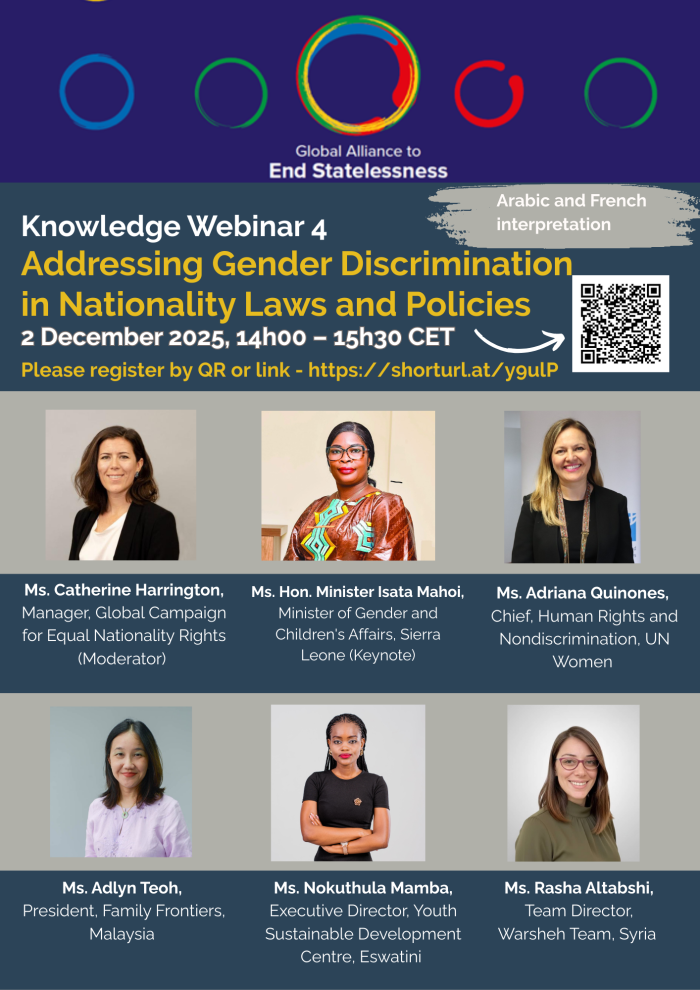
On 2nd December 2025, Catherine Harrington, Manager of the Global Campaign for Equal Nationality Rights, moderated the fourth Global Alliance Webinar on Addressing Gender Discrimination in National Laws and Policies. Opening the event, she reminded participants that over forty-five countries still maintain nationality laws that discriminate based on gender. Twenty-four of these do not permit women to confer nationality on their children on an equal basis with men, making gender-discriminatory laws one of the root causes of statelessness.
She welcomed five inspiring women – speakers representing government, the UN, and civil society – united in their dedication to ending what Harrington called “this man-made injustice” of gender-unequal nationality rights.
Hon. Dr. Isata Mahoi, Minister of Gender and Children’s Affairs of Sierra Leone, showcased the country’s landmark reforms in 2017, granting women equal rights to pass citizenship to their children, positioning the country as a model. Celebrating this milestone, she stated that “women are no longer treated as second-class citizens,” while warning that legal reform is not enough: ratifying the 1954 Convention Relating to the Status of Stateless Persons and the 1961 Convention on the Reduction of Statelessness and ensuring effective implementation remain essential.
Adriana Quinones, Chief of the Human Rights and Non-Discrimination Section at UN Women, described nationality rights as “gatekeepers of all other rights,” often determining access to education, health, and basic services. She emphasized that discriminatory laws violate international standards, including the Convention on the Elimination of All Forms of Discrimination Against Women and the Convention on the Rights of the Child, and that equality in nationality rights is a non-negotiable prerequisite for the achievement of multiple Sustainable Development Goals.
Raising Awareness by Empowering Those Affected
Adlyn Teoh, President of Family Frontiers in Malaysia, shared the personal story that led her into activism. Her son was born stateless and spent ten years in legal limbo, shut out from timely enrolment in school and charged prohibitive fees for healthcare as a “non-citizen”. For years she blamed herself, until she realized the problem was embedded in law: as a Malaysian woman, she could only apply for her child’s citizenship, while Malaysian men in the same situation could register their children as citizens by right. Her advocacy united mothers across Malaysia, putting a human face to this injustice. By engaging parliament, litigating strategically and working with the media, Family Frontiers and the collective mobilization helped build public pressure that led to a constitutional amendment to recognize women’s equal right to confer nationality to their overseas-born children. That amendment now needs to be fully implemented so that families see the benefits in practice.
Contextualizing the Issue, Towards Collective Action
Nokuthula Mamba, Director of the Youth Sustainable Development Centre in Eswatini, stressed how local context shapes the fight against statelessness, highlighting how only Swazi men can automatically pass citizenship to their children in Eswatini. Her organization works with youth, affected families, traditional leaders and government ministries to reframe gender discrimination in nationality law as a development challenge that undermines national plans and the SDGs.
Rasha Altabshi, Director of the Warsheh Team in Syria, spoke about the legacy of a nationality law that allows men, but not women, to pass nationality freely to their children and foreign spouses. Fourteen years of conflict, displacement and return have magnified the impact of this discrimination: children without documents struggle to enroll in school, access basic services or receive humanitarian assistance, and many Syrian women returning home cannot bring their children without costly “foreigner” visa fees. With Syria entering a new transitional phase and a constitutional declaration that affirms equality of all citizens, she called for reform of nationality law – and the lifting of reservations to CEDAW – as a core benchmark of genuine reconstruction and inclusive state-building.
All speakers stressed that the impact of gender-discriminatory nationality laws are not rare, individual tragedies but rooted in systemic injustices that affect entire societies. They are also among the most solvable human rights problems: they do not require major financial investment, only political will, inclusive law reform and effective implementation. Through the Global Alliance’s Thematic Working Group on Addressing Discriminatory Nationality Laws and Policies and its wider membership, governments, UN partners, civil society and stateless-led organizations are working together to ensure that no woman is treated as a second-class citizen – and no child is left without a nationality – because of discrimination in the law.
For a deeper dive into these efforts to ensure equal nationality rights, check out the full webinar recording here.
11 February 2026
Support the Joint Statement: Advancing Vocational Inclusion of Stateless People Across the UN
As part of a multi-pronged advocacy approach to scale up UNHCR’s good practice of removing barriers to the employment of stateless persons, the Joint Statement, drafted by Apatride Network, seeks to encourage all UN entities to follow suit. We are calling on Global Alliance members and other organizations to endorse it and sign on.
Read more6 February 2026
Call for Applications: UNHCR Global Advisory Board of Organizations Led by Forcibly Displaced and Stateless Persons
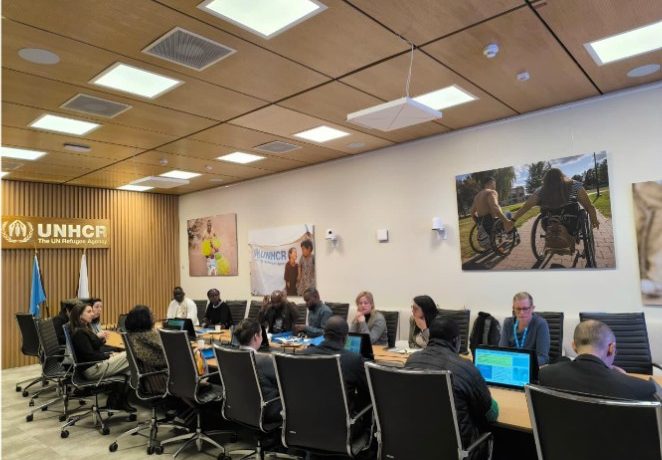
The United Nations High Commissioner for Refugees (UNHCR) has launched a Call for Expression of Interest for its Global Advisory Board of Organizations Led by Forcibly Displaced and Stateless (2026–2028). We strongly encourage stateless-led organizations within the Global Alliance network and beyond to apply by 8 February and bring their expertise and lived experience to this important global platform.
Read more8 January 2026
Realizing the Right to Education for Stateless Persons
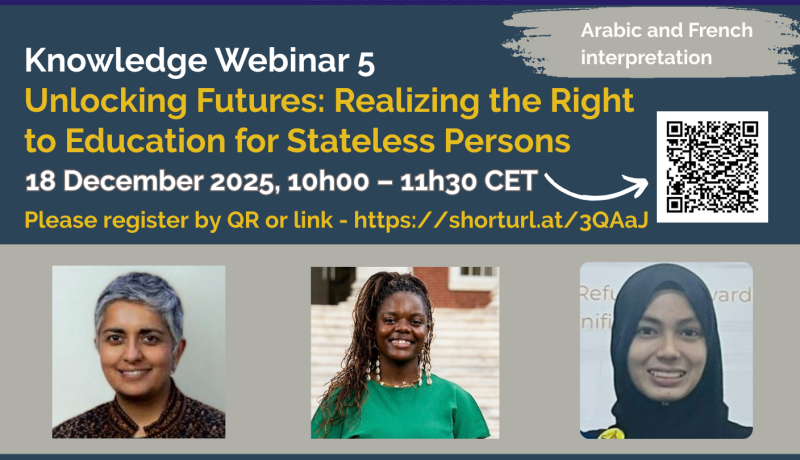
On 18 December 2025, Radha Govil, Deputy Director of the Peter McMullin Centre on Statelessness and Co-lead of the Thematic Working Group (TWG) on Protecting the Rights of Stateless Persons, moderated the fifth and final Global Alliance webinar of the year: “Unlocking Futures: Realizing the Right to Education for Stateless Persons.”
Read more