Strengthening statelessness data: International Recommendations on Statelessness Statistics (IROSS)
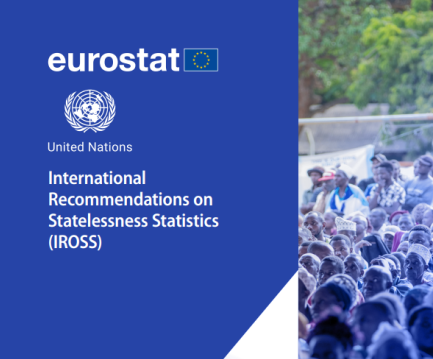
Reliable data on statelessness remains a major global gap. While at least 4.4 million people were reported as stateless or with undetermined nationality at the end of 2024 worldwide – based on data from 101 States submitted to UNHCR, the true scale is significantly higher due to gaps in data collection, inconsistent methodologies, and limited state reporting. In many contexts, stateless populations remain invisible in official statistics – whether due to technical limitations, lack of prioritization, or political sensitivities.
Against this backdrop, the International Recommendations on Statelessness Statistics (IROSS), adopted by the United Nations Statistical Commission (UNSC) in 2023, represent an important step forward. This guidance is highly relevant as states and partners seek to strengthen evidence-based responses to statelessness.
Developed by the Expert Group on Refugee, Internally Displaced Persons and Statelessness Statistics (ERGISS), bringing together around 40 countries and 30 international and regional organizations, the International Recommendations on Statelessness Statistics (IROSS), published by EUROSTAT in March 2026, aim to improve the production, overall quality, coordination, and dissemination of statistics on stateless populations.
The guidance provides a comprehensive statistical framework and recommendations to support national statistical systems and other relevant stakeholders in generating more reliable and comparable data. It encourages countries to systematically include statelessness in censuses, household surveys, and administrative data systems, and to better capture not only those formally recognized as stateless, but also people without a recognized nationality status.
At national level, stronger data can support more effective policies, helping governments identify populations affected by statelessness, understand root causes, and design targeted solutions. At global level, improved data contributes to more coherent international responses and strengthens accountability and cooperation.
The Global Alliance to End Statelessness welcomes IROSS as a practical and timely tool. Its implementation can help address persistent data gaps, improve visibility of affected populations, and support more effective advocacy and policy development.
States are encouraged to make full use of this guidance, including by integrating its recommendations into national statistical systems and engaging with international and regional partners to strengthen capacity and peer learning.
Improving data is not an end in itself – but it is a critical step towards ensuring that no one remains invisible, and that permanent solutions to statelessness can be achieved.
7 May 2026
Thinking of a Gift for Mother’s Day? Support Equal Nationality Rights for Mothers
This Mother’s Day, countries across Africa will celebrate mothers and the importance of family life. Yet as we honor motherhood and the important role of families, seven countries in Africa continue to be among the 24 globally with nationality laws that deny women the right to confer nationality on their children on an equal basis with men. Additionally, nationality laws in approximately 40% of African countries do not provide women with the same rights as men to confer nationality on a noncitizen spouse.
Read more11 March 2026
Human Rights Council side event highlights solutions to childhood statelessness

On 2 March 2026, the Global Alliance to End Statelessness and partners convened a side event during the 61st session of the UN Human Rights Council titled “Every Child’s Right to a Nationality and Identity: Preventing Childhood Statelessness.” The event brought together governments, UN agencies, regional organizations, civil society and stateless-led groups to exchange experiences and highlight practical solutions to ensure that no child is born without a nationality.
Read more11 February 2026
Support the Joint Statement: Advancing Vocational Inclusion of Stateless People Across the UN
As part of a multi-pronged advocacy approach to scale up UNHCR’s good practice of removing barriers to the employment of stateless persons, the Joint Statement, drafted by Apatride Network, seeks to encourage all UN entities to follow suit. We are calling on Global Alliance members and other organizations to endorse it and sign on.
Read more